For the last five years, if you asked a small business owner how they connected their software, the answer was always the same: “I just use Zapier.” It was the undisputed king of no-code automation. You paid a monthly subscription, clicked a few buttons, and suddenly your Facebook Lead Ads were magically appearing in your Mailchimp audience list. It felt like witchcraft when it first launched.
I remember my first Zap. I was running a tiny consulting firm and spending six hours a week manually copy-pasting client data from Typeform into a messy Google Sheet. When I finally set up that two-step automation in Zapier, I stared at the screen as a new row populated itself. I felt like a Silicon Valley genius.
But it is 2026, and the automation landscape has fractured. We are no longer just moving a row from a Google Sheet to an Airtable database. We are orchestrating complex, multi-modal AI agents that parse large datasets, make autonomous decisions, and execute real-world tasks. The simple point-A-to-point-B logic that built Zapier’s empire is now wildly insufficient for building autonomous businesses.
To bridge this gap, Zapier introduced their Model Context Protocol (MCP), aiming to tightly integrate Large Language Models directly into their large app ecosystem. Suddenly, your Zaps had a brain. Meanwhile, n8n the quiet, open-source underdog surged in popularity by offering unprecedented control, visual mapping, and local AI orchestration that treated language models as first-class citizens rather than bolted-on accessories.
I run a portfolio of automated businesses ranging from content generation to niche B2B lead generation. My entire livelihood depends on these tools not breaking when the traffic spikes or the API variables randomly change. I have spent the last six months testing both Zapier MCP and n8n in live, high-volume production environments.
Here is my , unfiltered breakdown of which platform actually wins for small businesses today, and why your choice will alter your profit margins over the next twelve months.
The Contenders: Zapier MCP vs. n8n at a Glance
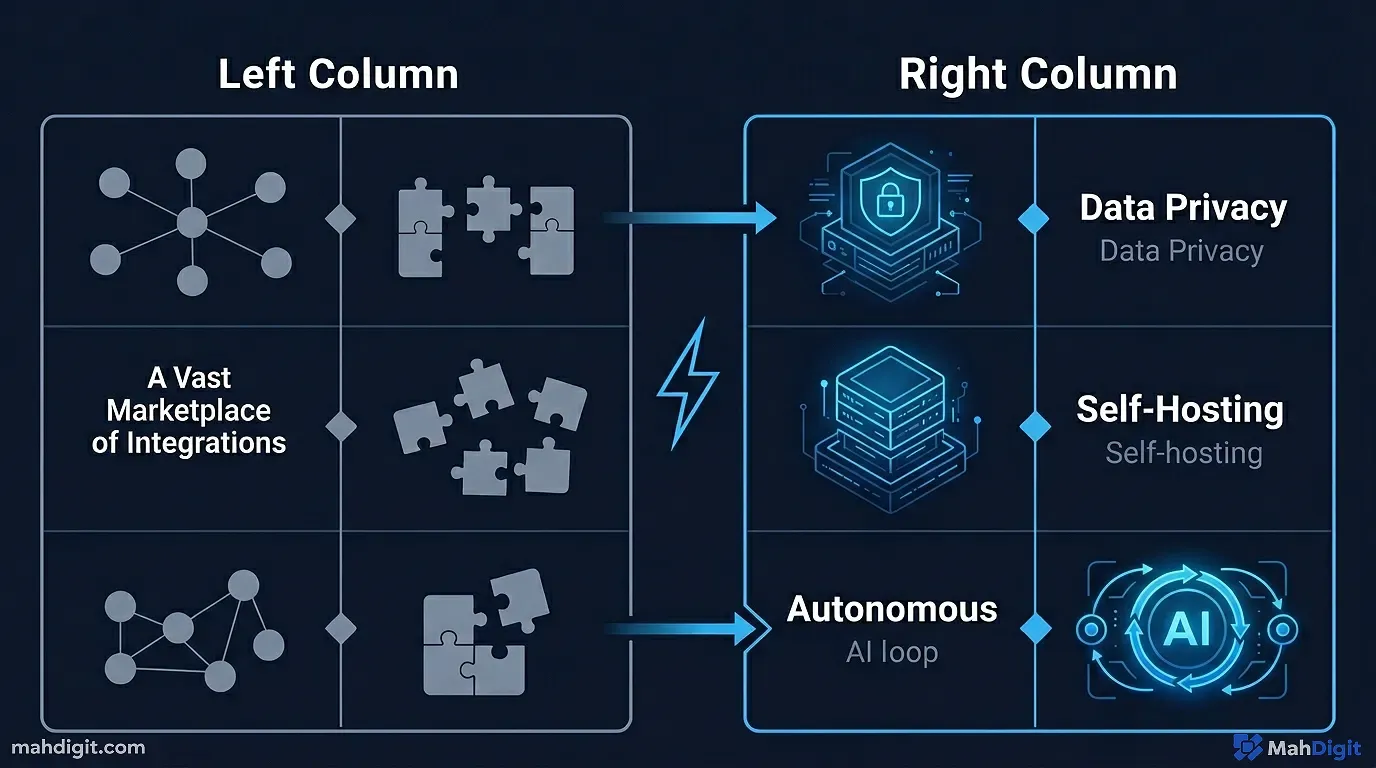
Before we get into the technical comparison, let me define what we’re actually comparing. The philosophy behind these two tools could not be more different.
Zapier (with MCP): The Apple Ecosystem
Zapier is the Apple ecosystem of automation. It is incredibly polished, user-friendly, and integrates with everything (over 8,000 apps at the time of writing). The introduction of MCP (Model Context Protocol) allowed users to seamlessly plug AI agents (like ChatGPT or Claude) directly into these integrations without writing complex API calls.
You do not need to understand JSON payloads, webhook headers, or OAuth2 authentication flows to use Zapier. The platform abstracts all that challenging technical jargon away. You just authenticate your account via a popup window and map the fields using a dropdown menu. It is brilliantly accessible.
n8n: The Linux of Automation
n8n is the Linux of automation. It utilizes a node-based visual editor that looks like a flowchart. The core difference? It is open-source and “source-available.” You can pay for their cloud hosting to get the Zapier-like experience, or you can host it yourself entirely free of platform charges.
It is inherently more complex. You will likely have to look at JSON outputs and understand basic data structures. But that complexity buys you absolute, unrestricted freedom over your data and execution logic. You are never waiting for n8n to officially “support” an app; if the app has an API, you can build the connection yourself in five minutes.
If this sounds overwhelming and you are completely new to setting up automated workflows, I recommend reading my Build an AI Workflow guide first to understand the basic mechanics of how these platforms function before choosing one to base your business upon.
Round 1: Ease of Use vs. main Control
Most small business owners are not software engineers. They do not want to learn JavaScript just to automatically send a welcome email to a new Stripe customer. They want to set it and forget it. This is where the battle lines are drawn.
The Zapier Experience: Pristine Lines
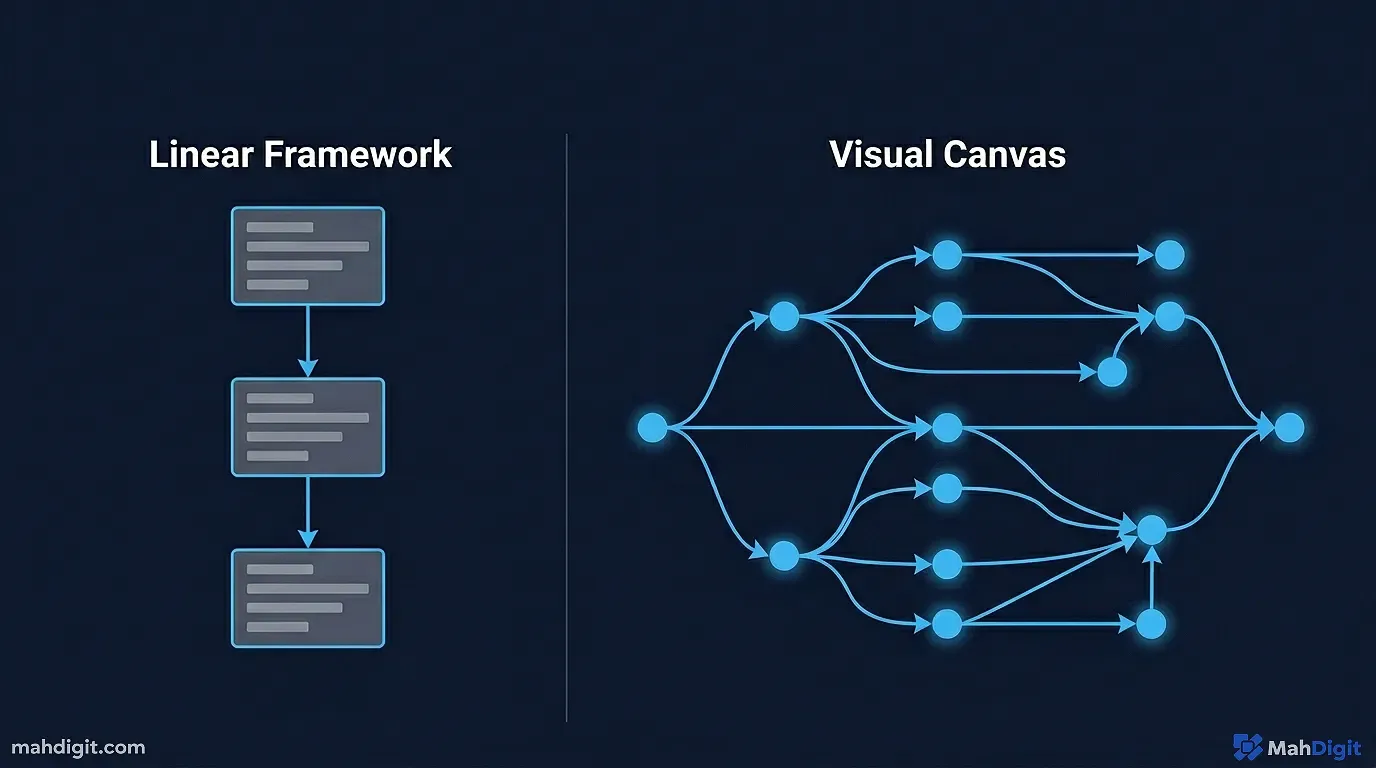
Zapier’s UI is pristine. Building a “Zap” is a masterclass in onboarding. You select a trigger, you select an action, you map a few text fields, and you are done. The introduction of MCP means you can now add a step that says, “Hey Claude, summarize the transcript from this Zoom call and extract the action items,” before passing that data to your CRM. It just works.
I successfully taught my sixty-year-old father, who struggles to attach PDFs to an email, how to build a 3-step Zap to organize his real estate inquiries. That level of accessibility is an undeniable superpower.
However, Zapier forces you into a rigid, linear box. Doing complex branching (if X happens do Y, but if Z happens loop back to A ten times) is an absolute nightmare of nested pathways. The Zapier interface was simply not designed for complex, non-linear logic. As soon as you try to build an AI agent that requires iterative loops or error handling, the editor becomes impossible to navigate or debug. When an error occurs on step 14 of a nested Zap, finding the root cause feels like digital archaeology.
The n8n Experience: The Visual Canvas
The first time you open n8n, it feels intimidating. It looks like a complex electrical engineering diagram. You drag visual “nodes” onto a canvas and wire them together. There are no linear rails protecting you.
But that initial learning curve reveals large power. In n8n, you can visually see the exact path of your data. You can split data streams, merge them back together, and write custom JavaScript snippets inside a node to format a weird date string.
Crucially, n8n orchestrates complex autonomous AI logic natively. When I build agents in n8n, I can use an “AI Agent” node, give it a system prompt, and wire it to “Tool” nodes (like a web scraper or a database query). The agent decides autonomously which tool to use, loops until it finds the answer, and then outputs the final result. Zapier MCP cannot replicate this level of autonomous looping without insane workarounds.
The Winner: It depends. For non-technical founders who just need basic A-to-B connections, Zapier wins easily. For anyone who wants to build actual AI products, complex logical loops, or autonomous agents, n8n destroys Zapier.
Round 2: The Pricing (Where Things Get Bloody)
Here is where I get frustrated with the automation industry, and where small businesses need to pay very close attention because the pricing structures between these two platforms operate in different universes.
The Zapier “Task Tax”
Zapier prices its platform based on “Tasks.” A task is counted every time an action step successfully completes. This sounds reasonable until you try to build something robust.
If you have a Zap that triggers when a sale happens on Shopify, formats the customer’s name (1 task), sends an intro email via Gmail (1 task), logs the transaction to an Airtable spreadsheet (1 task), triggers an AI sentiment analysis via MCP (1 task), and notifies your team in Slack (1 task) that is 5 tasks for a single sale.
If you get 500 sales a month, that is 2,500 tasks. Zapier’s pricing scales based on task volume. By the time you start doing serious data manipulation, parsing hundreds of RSS feeds, or running high-volume e-commerce, your Zapier bill can easily hit $200+ per month.
I once built an aggressive web scraping tool in Zapier that pulled 50 articles a day and parsed them through ChatGPT. My Zapier task limit was exhausted in under four days, and they wanted $600 to upgrade my tier for the month. You are essentially being financially penalized for building complex automations.
n8n’s Execution Model (And the Self-Hosted Cheat Code)
n8n approaches pricing entirely differently. They charge based on “Executions.” An execution is the entire run of a workflow, from trigger to completion, regardless of how many steps or nodes are inside it.
That 5-step Zapier workflow I mentioned above that burns 5 tasks per sale? In n8n, that only counts as one execution. If you are building complex AI workflows that require looping through databases, scraping dozens of web pages, and making countless API calls per trigger, n8n will save you thousands of dollars a year.
But here is the real kicker: You can self-host n8n for free.
If you have a basic understanding of Docker or are willing to follow a 20-minute YouTube tutorial, you can install the community edition of n8n on an $8/month DigitalOcean droplet or even a physical machine in your house. Once self-hosted, you can run unlimited executions with zero platform fees. You pay for your own hardware or cloud server, and n8n runs entirely unrestricted.
(See my guide on no-code AI automation for a broader breakdown of AI platforms).
The Winner: n8n by an absolute landslide. Zapier’s pricing model punishes complexity and scales punitively. n8n’s pricing model encourages large scale, and self-hosting breaks the pricing model entirely in the user’s favor.
Round 3: Integration Ecosystems
An automation platform is essentially useless if it cannot securely and reliably connect to the specific software stack your business relies upon.
Zapier’s Iron Grip
Zapier integrates with over 8,000 apps. If a piece of software exists on the internet and has more than ten users, there is a 99% chance it has a native Zapier integration. This is their strongest, most impenetrable moat.
You never have to read an API documentation page. When a client tells me they use a hyper-niche plumbing dispatch software built in 2018, I can usually find it on Zapier. With the introduction of MCP, linking these thousands of apps to advanced LLMs takes three clicks. It is unparalleled breadth.
n8n’s Expanding Library (and the API Escape Hatch)
n8n has significantly fewer native “nodes” (around 1,000+). They definitely cover all the major players you would expect (Stripe, Slack, Airtable, HubSpot, major AI models, Google Workspace). However, if you use a truly obscure piece of software, they might not have a drag-and-drop node pre-built for it.
But n8n has an incredibly powerful “HTTP Request” node. If the software you use has an open REST API, you can connect to it in n8n easily. The catch? You will have to actually read their API documentation, find their endpoints, authenticate manually, and construct the JSON request yourself. It requires technical literacy.
The first time I had to construct a raw HTTP request in n8n to connect to a legacy CRM, I wanted to pull my hair out. I spent three hours battling authentication tokens. However, once I figured it out, I realized I was no longer chained to a platform’s “officially supported” list apps. I could build anything.
The Winner: Zapier. For the sheer volume of plug-and-play integrations and the avoidance of reading API docs, Zapier is still undefeated in pure connectivity.
Feature Comparison Matrix

To make this clear and easy to scan, here is how the two platforms stack up for a typical small business operating in 2026.
| Feature | Zapier (with MCP) | n8n |
|---|---|---|
| Ideal User | Non-technical founders, Marketers, Solopreneurs | Developers, Technical Operators, Agencies |
| Pricing Model | Punitive (Per Task) - rapid cost escalation | Generous (Per Execution) - built for scale |
| Self-Hosting Options | None. Cloud only. Entirely proprietary. | Yes. Free Community Edition via Docker/npm. |
| Native Integrations | 8,000+ (Unbeatable market dominance) | ~1,000+ (Requires HTTP API knowledge for others) |
| Complex Logic / Looping | Clunky, expensive, and difficult to debug | Visual, intuitive, built for looping algorithms |
| Data Privacy / HIPAA | Enterprise plan required ( expensive) | secure and compliant if self-hosted ($) |
| AI Agent Orchestration | Easy for simple, linear analysis tasks | integrated for complex autonomous agents |
| Debugging / Error Logs | Difficult to parse deep within nested steps | Visual indication showing which node failed |
The Data Privacy Argument (Why Law Firms Hate Zapier)
If you are a solo marketing consultant, data privacy might not be your top priority. But if you run a law firm, a medical practice, or a financial advisory service, you cannot blindly pipe your client data through a third-party server located in California.
Zapier processes all of your data through their servers. If you are handling Protected Health Information (PHI) or sensitive litigation documents, sending that data to Zapier, which then routes it to OpenAI via MCP, is a large compliance violation unless you are on their exorbitant Enterprise tier with a signed Business Associate Agreement (BAA).
With a self-hosted n8n instance, the data never leaves your physical server or your secured cloud droplet until you explicitly tell it to. If you pair self-hosted n8n with a local LLM running via Ollama, you create a completely hermetically sealed AI environment. You can summarize sensitive internal documents and patient records without a single byte of data hitting the public internet. This is a large selling point if you are looking to build a B2B automation agency.
The Verdict: Which Should You Choose?
I do not believe in generic “one size fits all” recommendations. Your choice dictates the technical debt of your entire business operations for years to come. Do not make this decision lightly.
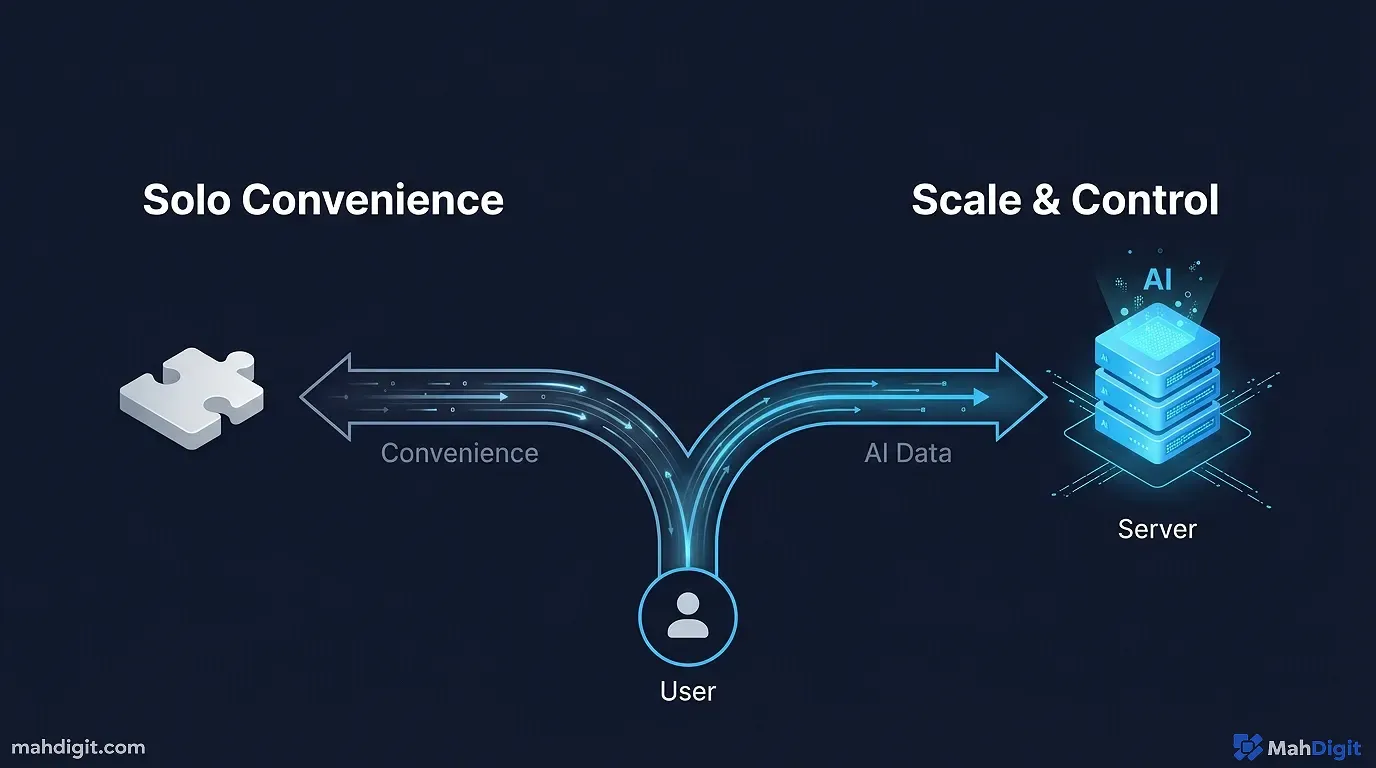
Choose Zapier if: You are a solo agency owner, a local service business, or a creator who needs to connect basic SaaS tools instantly. If you value your time drastically more than your software budget, and the thought of writing a JSON payload or spinning up a server makes you sweat, pay the Zapier tax. The ease of use and the seamless MCP integration will get you operational in 30 minutes.
Choose n8n if: You are technically inclined, you process a high volume of data, or you plan to build AI-driven products or B2B automation services. If you are building “agents” that require extensive looping logic, memory retrieval, and complex conditional routing, n8n is usually the better fit. n8n’s pricing structure and self-hosting capabilities can make scaling more sustainable in 2026 without crushing margins.
Key Takeaways
Do not blindly follow the hype train generated by tech influencers on Twitter. Audit your technical skills and your actual business needs before locking your entire data flow into a proprietary ecosystem.
- Zapier is the undisputed king of convenience. With 8,000+ integrations and a pristine UI, it remains the fastest way to automate basic, linear tasks without coding knowledge.
- Zapier’s pricing model punishes complexity. Because they charge per “Task,” multi-step AI workflows or data-heavy loops will rapidly drain your budget.
- n8n is the king of control. The visual, node-based editor allows for complex branching logic, custom JavaScript execution, and deep, autonomous agent loops.
- n8n’s pricing encourages scale. By charging per “Execution” rather than per task, it is cheaper for complex, multi-step workflows.
- Self-hosting n8n is an unassailable superpower. Running the free community version gives you unlimited automation power and strict data privacy, shielding you from cloud costs.
- n8n requires more technical grit. Be prepared to read API documentation and learn basic JSON to connect to obscure tools without native nodes.
- Data sovereignty favors n8n. If you deal in sensitive health, legal, or financial data, self-hosting n8n is the safest route to compliance.
Pick your weapon carefully. The right automation platform will work silently in the background like an invisible employee, making you money while you sleep. The wrong one will become a bloated, expensive nightmare that you are terrified to edit. Make the choice based on where you plan to be in three years, not just what is easiest today. Ready to go deeper? Check out my breakdown on no-code AI automation and building an AI workflow.
