You open ChatGPT, type “write me a marketing email,” and hit enter. You wait two seconds, and get back something that sounds like a generic robot reading a corporate dictionary. Does that sound familiar?
The problem isn’t the AI modelit’s almost entirely the prompt. A vague, unstructured instruction produces a vague, unhelpful answer. A specific, well-structured prompt produces output that’s genuinely useful, reducing your editing time to seconds rather than hours. When I first started consulting on AI implementation for marketing teams, I watched senior copywriters abandon Claude simply because they were giving it three-word instructions and expecting telepathy.
This comprehensive AI prompting guide will teach you a simple, repeatable formula for writing AI prompts that actually work. No coding required. No overwhelming technical jargon. Just practical techniques you can copy and use in ChatGPT, Claude 3.5 Sonnet, Gemini 2.0, or any other major AI tool starting today.
Why Most People Get Disappointing AI Results
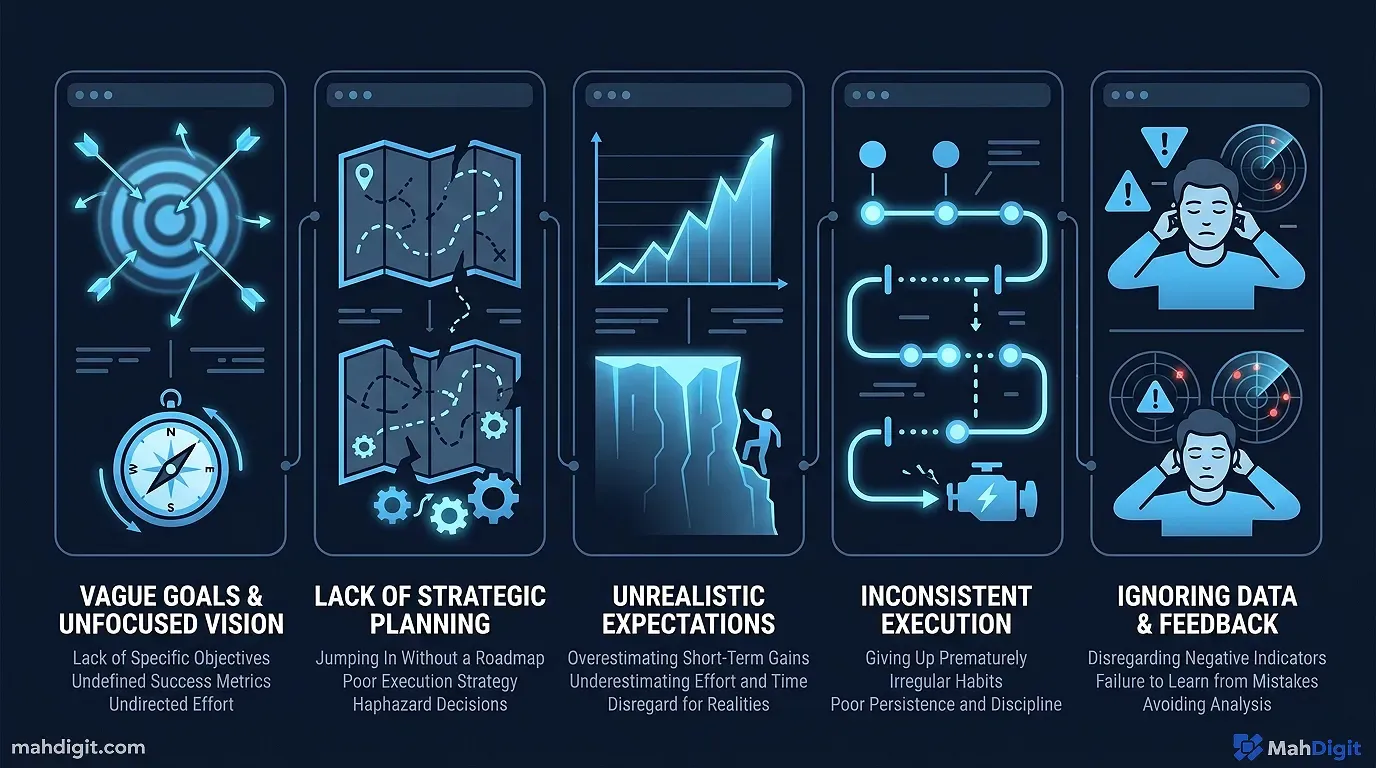
Here’s the uncomfortable truth: most people type prompts the same way they’d text a busy friendhyper-short, overly casual, and missing half the required context. The AI doesn’t complain or ask clarifying questions; it just guesses what you meant. And guesses are rarely what you actually want in a professional business setting.
Here’s a horrifyingly real example I reviewed from a client’s ChatGPT history last week:
Bad, lazy prompt: “Write a blog post about productivity.”
The AI doesn’t know who you are writing for, what your unique angle is, how long it should be, what tone to utilize, or what your specific expertise is. So it simply outputs 500 words of generic, flavorless filler that could have easily been written on a 2011 WordPress blog.
Now, compare that to this:
Better, structured prompt: “You are a ruthless productivity coach writing exclusively for burnt-out freelance graphic designers. Write a 1,200-word blog post explicitly detailing the 3 biggest time-wasting administrative habits freelancers have and how to fix them using AI tools. Use a conversational, slightly blunt, but encouraging tone. Include two specific software tool recommendations per habit.”
Same exact AI model. Completely different output quality. The fundamental difference? Rigorous structure.
The R-C-T-F Formula: The 4 Core Elements of Every Great Prompt
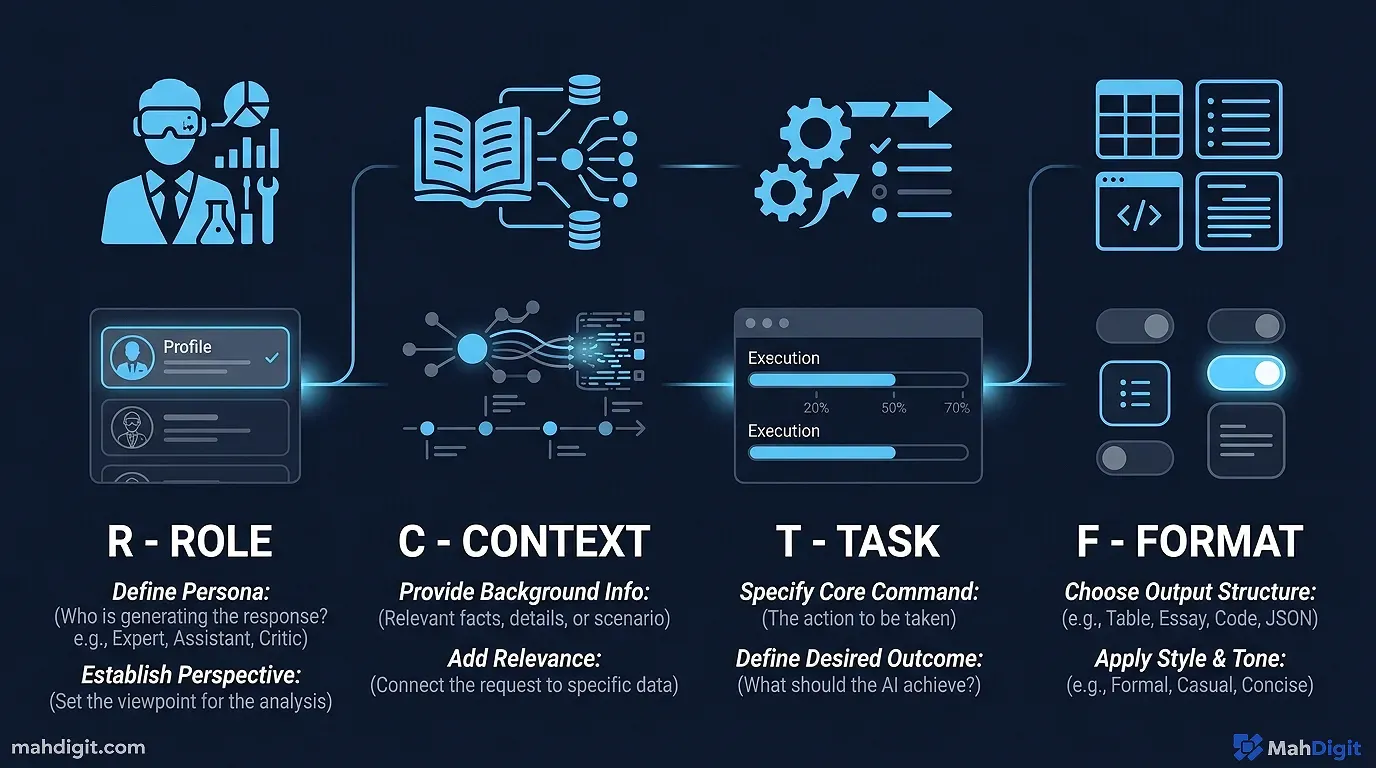
After relentlessly testing thousands of prompts across ChatGPT, Claude, and Gemini for my own agency brand, I’ve concretely found that the absolute best prompts consistently include four distinct elements. I simply call it the R-C-T-F framework:
| Element | What It Means Operationally | Practical Example |
|---|---|---|
| Role | Who the AI should act as intellectually | ”You are a senior UX copywriter” |
| Context | The crucial background info the AI needs | ”for a fast-growing B2B SaaS company targeting skeptical HR managers” |
| Task | What specifically you want it to execute | ”Write 5 aggressive subject lines for an abandoned cart email workflow” |
| Format | how to visually deliver the final answer | ”As a markdown numbered list, under 45 characters each” |
You don’t always need to deploy all four for basic questions. But for serious professional work, the more elements you deliberately include, the stronger your results will inevitably be.
Putting R-C-T-F Together in Reality
Here is how the framework actually looks in action:
Role: You are a experienced direct-response email marketer.
Context: I am launching a brand new AI automated scheduling tool built explicitly for solo plumbers and electricians.
 The audience is non-technical, overworked, and values absolute simplicity over fancy features.
Task: Write 5 distinct email subject lines for the launch announcement to our warm waitlist.
Format: Numbered list. Each subject line must be under 50 characters. mix curiosity and urgency. Do not use emojis.
The exact AI output I received:
- Your new dispatch calendar is live
- Stop losing jobs to missed calls
- We built this for solo plumbers
- Book jobs while you are driving
- Get 5 hours back this Thursday
That entire technical operation took 20 seconds to write and well produced usable, non-cringe ad copy. No heavy revisions needed.
5 Powerful Prompt Templates You Can Copy Today
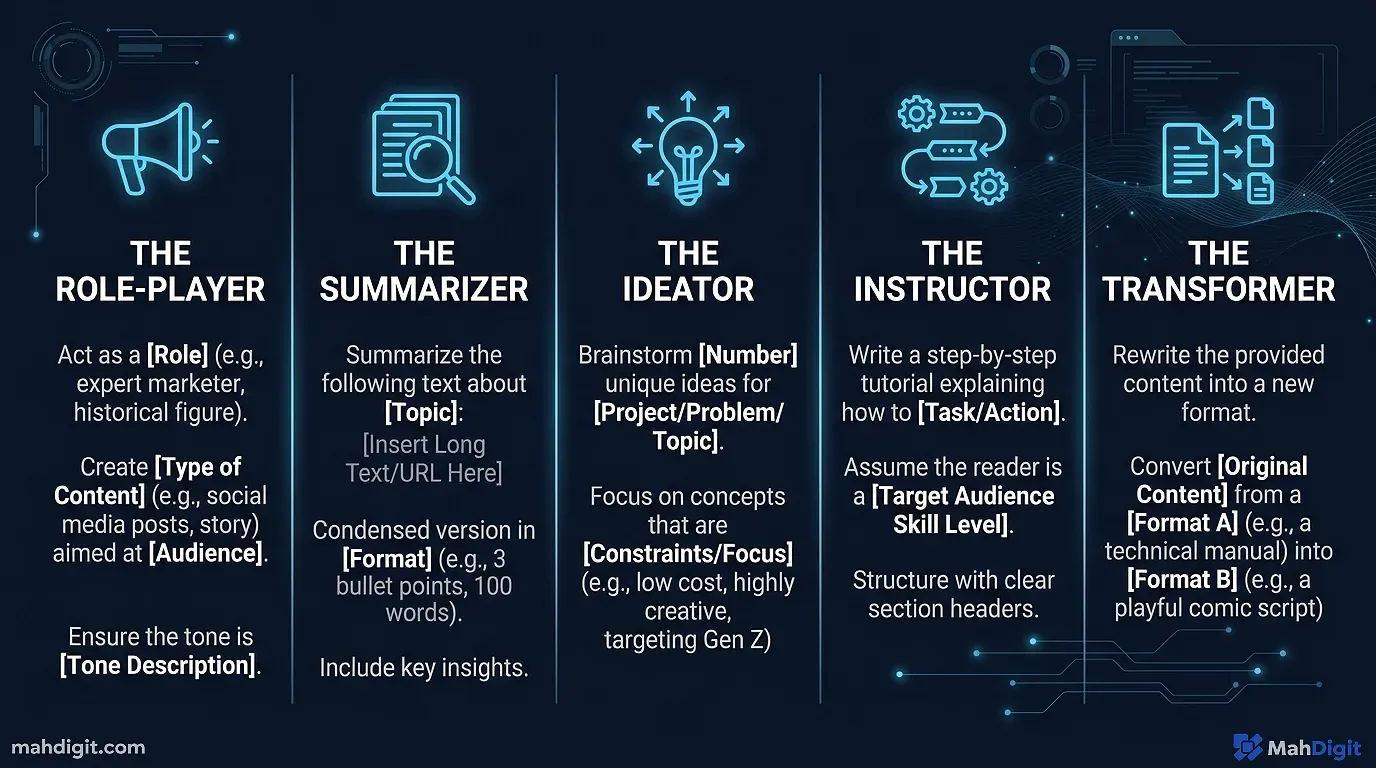
Below are five aggressive templates I personally use daily at MahDigit. Copy them permanently, swap the bracketed variables for your specific context, and paste them into any AI interface.
1. High-Stakes Email Drafting
You are a professional crisis communications writer. Write a [tone: firm/empathetic/urgent/apologetic] email to [recipient name/role] explicitly regarding [specific topic or bad news].

Crucial context: [explain what happened and why it matters in one sentence].
Keep the entire draft under [word count limit] words. Avoid all corporate jargon.
Include a clear, singular call to action at the very end.
When my agency missed a crucial server migration deadline for an enterprise client, I used this exact template to draft the apology note. It removed my defensive emotions and produced a accountable, professional update.
2. Messy Meeting Notes Clean Action Items
Act as an elite executive assistant. Here are my raw, disorganized meeting notes from a chaotic strategy call:
[paste notes]

Extract all concrete action items. For every single item, explicitly include:
- Who is responsible
- What the specific deliverable actually is
- The exact deadline (flag it if it wasn't mentioned)
Format this purely as a structural markdown table.
3. Rapid Market Research & Software Comparison
You are an unbiased enterprise technology analyst. compare [Tool A] vs [Tool B] specifically for [my specific use case].
You must cover: hard pricing logic, ease of onboarding, best unique features, and the single biggest software drawback for each.
Format this entirely as a comparison matrix, and then give me a definitive one-paragraph recommendation based solely on my use case.
4. SEO-Optimized Content Outlining
You are a technical SEO content strategist. Create a detailed structural outline for a [word count]-word flagship blog post about [topic].
Target audience: [who they are and their exact pain point].
The entire post should target the primary keyword "[exact keyword]".

Output requirements: Include strong H2 headings, 3 key bullet points of evidence required under each section, and generate a clickable meta description (maximum 155 characters). Do not suggest a "Conclusion" header.
5. Advanced Spreadsheet Formula Troubleshooting
I am currently using [Google Sheets / Excel 365]. I have a sheet with [describe your raw data structure and exact column letters].
I need a single formula that [describe precisely what dynamic calculation you want to run].
Give me just the exact formula I need to copy-paste, followed by a brief, plain-English explanation of how the syntax actually works so I can edit it later.
Before & After: Dramatic Real Prompt Makeovers
Let’s break down three real, everyday promptsthe embarrassing lazy version and the optimized versionto see how the output quality transforms.
Makeover 1: The Social Media Ghostwriter
| Status | The Prompt | The Resulting Output Quality |
|---|---|---|
| R Lazy | ”Write a LinkedIn post about AI and the future.” | Truly awful. Generic, contains zero hook, and awkwardly reads like an automated Wikipedia entry. Uses words like “delve” and “leverage.” |
| Yes Elite | ”You are a blunt, pragmatic thought leader on AI operations for agencies. Write a LinkedIn post (maximum 150 words) about how non-technical founders can stop wasting money on AI today. Start with a provocative question. End with one specific software recommendation. Use short paragraphs. No emojis.” | engaging, possesses a specific hook, signals a clear audience, and sounds like a real human being typing on a keyboard. |
Makeover 2: The Enraged Customer Reply
| Status | The Prompt | The Resulting Output Quality |
|---|---|---|
| R Lazy | ”Reply nicely to this angry customer email from Sarah.” | defensive, overly formal, tone-deaf, and reads like an automated airline response bot. |
| Yes Elite | ”You are a seasoned customer success director at a B2B SaaS company known for radical transparency. Reply firmly to this frustrated customer email from Sarah. Acknowledge her specific frustration in the first sentence, explain the server outage simply without making excuses, and offer a concrete 10% credit. Tone: empathetic, calm, and utterly professional. under 100 words.” | Incredibly empathetic, intensely solution-focused, accountable, and well on-brand for a modern tech company. |
Makeover 3: The Talent Acquisition JD
| Status | The Prompt | The Resulting Output Quality |
|---|---|---|
| R Lazy | ”Write a generic job description for a senior marketing manager.” | Generic boilerplate HR-speak. It could belong to almost any corporation. Fails to attract top-tier talent. |
| Yes Elite | ”You are the Head of Talent at a 50-person, profitable, remote-first AI startup. Write a compelling job description for a Senior Marketing Manager who will own organic content strategy. Include: a blunt intro about why this role is incredibly difficult but rewarding, 5 actual daily responsibilities, 4 non-negotiable tech skills, and our async culture. Tone: exciting, completely authentic, zero corporate jargon.” | Hyper-specific, actively filters out the wrong candidates while attracting the right ones, and sounds distinctly human. |
Are you seeing the mathematical pattern yet? The superior AI prompting guide method gives the language model a distinct character, a strict boundary, and high-resolution context.
The Most Common Prompting Mistakes (and Their Instant Fixes)
After reviewing thousands of logs, these are the five critical operational errors we see business owners confidently make every single dayand the fastest way to fix them.
Fatal Mistake 1: Being Too Vague
The Core Problem: Typing “Write something clever about internet marketing.”
The Instant Fix: Force yourself to add who, what, for whom, how long, and what exact format. Constraints breed creativity in language models.
Fatal Mistake 2: Demanding Too Much Simultaneously
The Core Problem: “Write a full 12-month marketing strategy with an exact budget breakdown, timeline, core video channels, editorial content calendar, and tracking KPIs for my new hardware startup.”
The Instant Fix: break it into sequential steps. Start with: “Create a list of the 5 most effective aggressive marketing channels for a B2B hardware startup with a $5K/month budget constraint.” Once it answers well, then casually ask it to expand step two.
Fatal Mistake 3: Zero Format Specificity
The Core Problem: You urgently want three clean bullet points to copy-paste, but you get a large, unreadable 800-word block of dense text.
The Instant Fix: Always explicitly dictate the visual format to the AI. “Format as a numbered markdown list,” “Return this purely in a CSV table,” or “Write this in 3 short, punchy paragraphs.”
Fatal Mistake 4: Completely Forgetting the Audience Context
The Core Problem: The AI writes a academic essay when you needed a casual newsletter, completely missing the vibe of the industry.
The Instant Fix: Always securely inject one blunt sentence of environmental context: “Warning: My specific audience is non-technical small plumbing business owners in Texas” or “Crucial context: This is for a confidential internal board memo, not a public-facing blog post.”
Fatal Mistake 5: Blindly Accepting the Very First Output
The Core Problem: The very first response is roughly 80% there, but you get incredibly lazy, give up, and just publish it as-is. Everyone can immediately tell you used AI.
The Instant Fix: You must iterate. Reply back and say: “That’s directionally close, but make it significantly more conversational and remove the word ‘moreover’” or ” shorten the introduction section and add a concrete mathematical example in section 2.” Language models perform exponentially better with aggressive feedbacktreat it like managing an intern, not using a Google search bar.
Advanced Prompting Tips (That Are Still Beginner-Friendly)
Once your brain has fully mastered the basic R-C-T-F framework, these slightly technical techniques will instantly level up your output quality:
The Magic of Chain-of-Thought Prompting
Simply appending the phrase “Think step by step” or “Show your detailed logic before answering” forces the AI to break down its own processing, yielding exponentially more accurate, hallucination-free answersespecially for dense analysis or mathematical problem-solving tasks.
I urgently need to decide between subscribing to Notion or ClickUp for my chaotic 8-person performance marketing agency.
Think step by step: explicitly state what deep operational factors I should heavily consider, and logically prove which tool wins on each specific factor. Only then give me your final, definitive recommendation.
Elite Few-Shot Prompting (Providing Real Examples)
You can hack an AI’s tone by explicitly showing it what perfect looks like. Give it 12 real templates inside your prompt:
Write high-converting product descriptions for my boutique e-commerce store. Here is the exact aggressive, minimalist style I require:

Example 1: "The Everyday Canvas Tote Built for the commuter who refuses to compromise. Water-resistant waxed canvas. Heavily padded laptop pocket. Looks incredible on Monday morning and Saturday night."

Now, completely mimic that exact style and write similar punchy descriptions for:
1. A minimalist wireless phone charger
2. A premium standing desk anti-fatigue mat
3. Stealth noise-cancelling studio earbuds
The AI well mirrors your proprietary brand style well when you explicitly force it to stare at a reference.
The Power of Iterative Refinement
The absolute best enterprise results always come from multi-turn conversations. Here is my productive, repeatable pattern:
- The Architecture prompt: Heavy R-C-T-F structure with crystal clear instructions.
- The Calibration prompt: “Good start, but adjust the tonemake it much less formal and stop acting like a robot.”
- The Expansion prompt: “Now add a specific, painful real-world example right into the second paragraph.”
- The Logistics prompt: “Finally, automatically write an SEO meta description for this exact post (maximum 155 characters).”
Each rigorous conversational turn narrows the probability matrix closer to what your brain actually wanted.
The embedded video resource above visually walks through live, screen-recorded examples of prompt refinementan incredibly useful visual companion to the deep-dive techniques we’ve comprehensively covered.
Which AI Model Is Actually Best for Which Specific Prompts?
Not all language models are equally capable in 2026. Here is my agency’s ruthless quick guide based entirely on aggressive daily production testing:
| The Specific Task Type | The Elite Tool | The Reason Why |
|---|---|---|
| Deep, long-form writing (1,500+ organic words) | Claude 3.5 Sonnet | Better narrative coherence on long outputs, obeys formatting constraints well, and sounds less robotic. |
| Rapid brainstorming & basic frameworks | ChatGPT (GPT-4o) | Blindingly fast, creative, excellent at spitting out lists and aggressive ideation. |
| Heavy internet research with live sources | Perplexity AI | Actively cites web sources natively, which reduces the risk of hallucinated claims and fake links. |
| Production-grade image generation | Midjourney v6 | By far the absolute best visual fidelity and lighting quality for professional, non-stock styles. |
| Heavy coding & complex technical syntax | Cursor / GitHub Copilot | Elite code generation integrated with large total codebase context awareness. |
| Final grammar polish & live editing | Grammarly Pro AI | Purpose-built explicitly for ruthless editing; integrates seamlessly everywhere you actively type on the web. |
Agency Pro Tip: combine them. Use the right elite tool for the exact right phase. I routinely start messy brainstorming in ChatGPT, migrate to Claude to draft the dense 2,000-word article, and fact-check the proprietary claims using Perplexity. It takes me 15 minutes to build an article backbone that previously took my team three total hours.
The Singular main Habit That Will 10x Your Routine AI Results
If you take only one profound thing away from this large guide, let it confidently be this simple rule: ** never, under any circumstances, accept the very first output.**
The initial response from any commercial AI model is functionally just a messy rough draft. It is merely a conceptual starting point. The real operational magic happens when you:
- Read the output critically What’s actually good? What sounds off-brand?
- Give specific, aggressive follow-up feedback “Make it punchier” beats “make it better.”
- ** iterate at least 23 times** Each rapid conversational round algorithmically gets you significantly closer to perfection.
Most frustrated people simply type one lazy prompt, sigh at the generic result, and declare “AI just isn’t that useful for my business.” The people getting remarkable results? They spend 60 extra seconds on specific follow-up prompts.
The R-C-T-F framework combined with relentless iteration is genuinely all you need. You do not need a $500 prompt engineering course. You do not need a library of expensive tool subscriptions. You just need a crystal clear structural expectation and the sheer willingness to refine.
Your Desktop Quick-Reference Prompting Cheat Sheet
Bookmark this page or screenshot this exact guide for your next heavy prompting session:
| Operational Step | The Actual Action Required | Expected Time |
|---|---|---|
| 1 | define the Role who should the AI confidently be? | 5 sec |
| 2 | Inject the Context who is the audience, what is the extreme situation? | 10 sec |
| 3 | State the dense Task legally, what does it need to produce? | 10 sec |
| 4 | Mandate the Format strict length limits, table structures, formatting | 5 sec |
| 5 | Review the output and ** iterate** with specific feedback | 3060 sec |
Total estimated operational time: under 2 minutes for a final output that previously used to take an expensive copywriter an hour.
Start Prompting Better Today
You do not need to memorize a thousand different commands. Just permanently burn R-C-T-F into your brainRole, Context, Task, Formatand build the ruthless habit of always iterating on the first generated output. That simple psychological shift alone will instantly put you ahead of 95% of casual AI users.
grab the templates provided above, force yourself to try one on a real work problem today, and clearly witness the structural difference for yourself.
Got a specific AI prompting guide question for your niche industry? Drop our consulting team a blunt message we personally read every single one and might feature your weird edge-case question in a future technical breakdown.
Related Articles
- AI for Content Creators: The Full Production Pipeline
- AI for Small Business: 7 Quick Wins to Start This Week
- AI for Students: A Practical Guide to Studying Smarter
- AI Meeting Notes: Stop Losing Action Items After Every Call
External Resources
- OpenAI Prompt Engineering Guide official techniques from the team that built ChatGPT
