Artificial intelligence tools have created a genuine, unavoidable tension in modern education. They are objectively powerful enough to write an entire undergraduate essay from scratchwhich is why so many universities immediately rushed to ban ChatGPT outright. But completely avoiding AI is a large tactical mistake. The exact same tools can help you understand notoriously difficult concepts dramatically faster, research more efficiently, and improve your own writing.
The fundamental difference between using AI as a crutch and using AI for students as a profound learning accelerator lies entirely in how you use it. When I was finishing my master’s degree last year, I never once submitted an AI-generated sentence, but I used Claude nearly every single day as a personal tutor. This guide is about that second approachusing AI as a tool that makes you a sharper student, rather than a plagiarism machine that bypasses the learning process entirely.
Everything outlined here is designed with strict academic integrity in mind. None of these seven techniques involve submitting AI-generated work as your own.
The Academic Integrity Line for AI
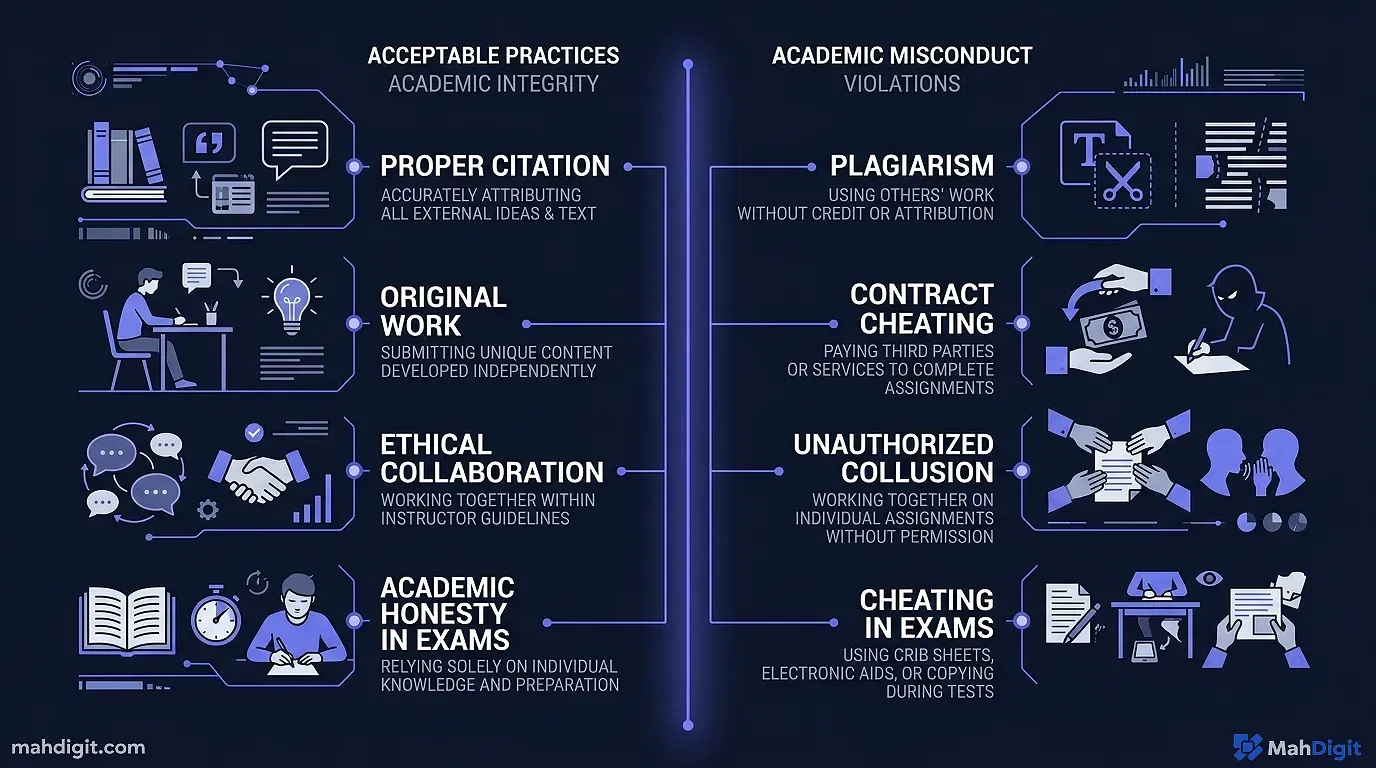
Here’s where the ethical line actually sits in most modern universities and it’s worth being explicit about this before anything else.
Generally okay (always check your specific professor’s syllabus):
- Asking an AI to explain a philosophical concept you’re struggling to grasp
- Having AI decode and explain the harsh feedback you received on a mid-term paper
- Using AI to brainstorm ten broad ideas that you then research and develop entirely yourself
- Getting AI to suggest related search terms or academic databases for a research project
- Using AI tools to check the grammar on a final draft you wrote yourself
Generally not okay (academic misconduct territory):
- Submitting any text output directly generated by an AI as your own original work
- Using AI to complete take-home exams, coding tests, or essay prompts
- Feeding an AI an essay, asking it to paraphrase the whole thing, and submitting it to bypass plagiarism checkers
Individual institutions have wildly different policies, and they’re evolving every semester. When in doubt, explicitly ask your instructor via email. The actionable techniques in this guide are designed to fall into the “learning accelerator” category.
1. Using AI for Students to Explain Anything You Don’t Understand
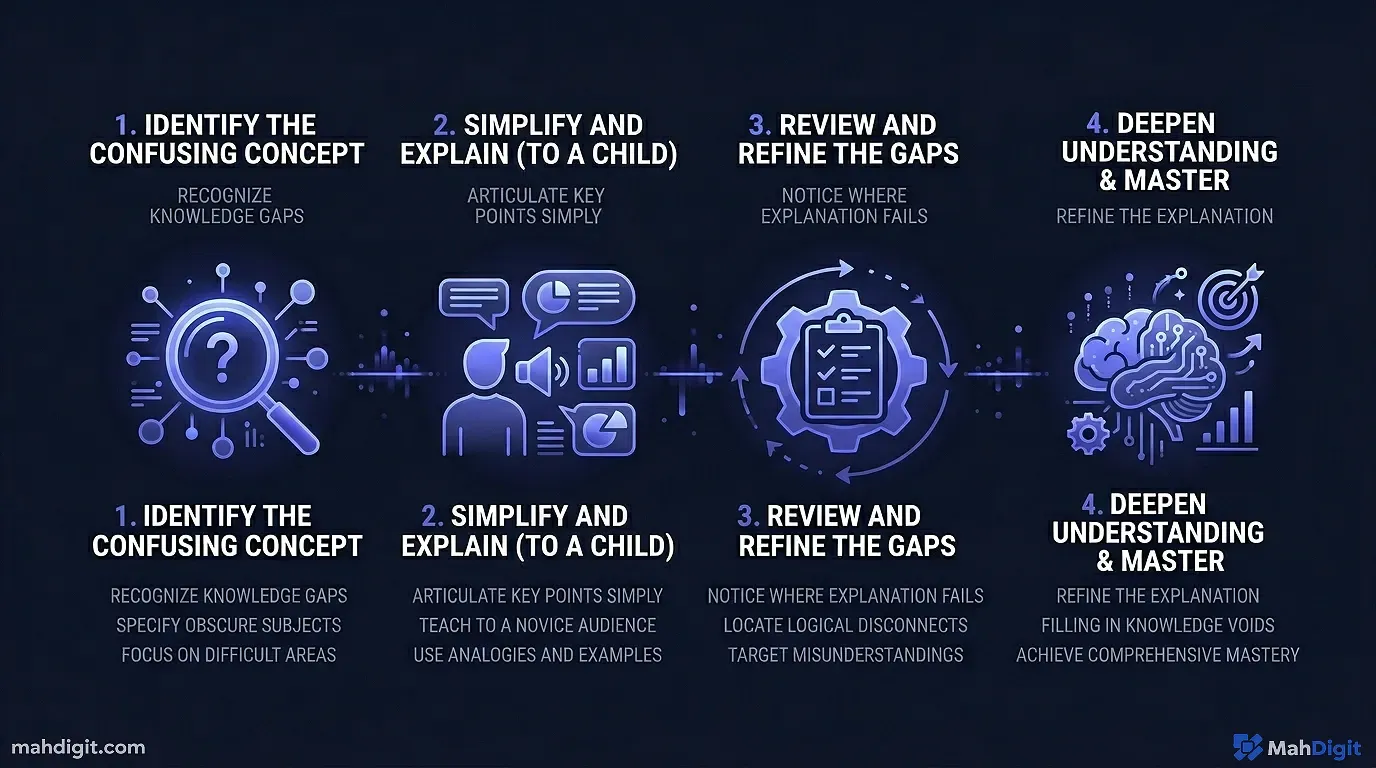
This is definitively the most valuable, underused AI capability in higher education. When a notoriously dense textbook explanation or a confusing biology lecture simply isn’t clicking in your brain, an LLM can instantly provide five completely different angles until one makes sense.
The Prompt Technique: Ask for multiple diverse frameworks simultaneously.
For example, when I couldn’t wrap my head around basic macroeconomics, I used this exact prompt:
Explain the complex concept of "opportunity cost" to me in 5 wildly different ways:
1. A simple, jargon-free one-sentence definition
2. An everyday analogy that involves buying coffee, not economics
3. The strict mathematical framework
4. A visual description (if I were drawing this on a whiteboard, what would it look like?)
5. A real-world example from a modern tech business decision
One of those five frameworks will almost always click in your brain where the dry textbook failed. Once you finally understand the foundational concept through the specific framing that works for your learning style, you can go back and easily make sense of the strict academic version.
This isn’t the AI doing your homeworkit’s the AI serving as an infinitely patient tutor who can explain the exact same difficult thing in ten different ways without ever getting frustrated with you.
2. Generate Active Recall Testing
If you look at the pedagogical research, one of the most evidence-backed study techniques is active recallaggressively testing yourself on the material rather than passively, comfortably re-reading your highlighted notes. The problem? Writing practice tests takes forever. AI makes this elite study method available on-demand for any topic.
The Prompt Technique: Paste your raw lecture notes and demand a rigorous quiz.
Here are my raw, messy lecture notes on [class topic]: [paste notes here]

Act as a strict college professor and create a 10-question quiz that genuinely tests my conceptual understanding, not just basic vocabulary recall:
- Mix short answer and complex multiple-choice questions
- Include at least 2 difficult, application-style questions where I have to apply the core concept to a brand new scenario
- Do not give me the answers immediately. Include the comprehensive answer key in a separate section at the very bottom.

Start with relatively easy baseline questions and build up to exam-level difficulty.
Close your notes, sit down, and actually answer the generated questions. The AI just built you a custom, targeted practice exam in 30 secondsa task that would have taken you 45 minutes of precious study time to build yourself.
3. High-Speed Research Starting Points
AI is elite at orienting you within a brand new academic topic before you dive blindly into primary sources. However, it is terrible at providing the primary sources themselves.
The Prompt Technique: Use AI to generate a comprehensive conceptual map of a topic, then do the hard, real research manually using that map.
I am researching [topic] for an undergraduate history paper. I know very little about it. Give me:
1. The 3-4 main competing schools of thought or historical positions on this specific topic
2. The 10 key vocabulary terms and concepts I must know before reading primary academic sources
3. 5 specific types of sources I should look for in my library database (e.g., "meta-analyses from 2015-2025," "landmark case studies")
4. The main unresolved debates currently happening in this academic field
Fair warning: Use this exclusively as a contextual roadmap, never as your bibliography. Go find the actual, citable sources through your university library database, Google Scholar, or JSTOR. AI-generated “citations” are notoriously fabricated in what researchers call “hallucinations”if you paste an AI citation into an essay, your professor will instantly know you cheated because the book does not exist.
For live, internet-sourced research starting points, I strongly recommend Perplexity AI over standard ChatGPT. It actively searches the web and clearly cites its sources with clickable footnotes you can manually verify.
4. Decoding Harsh Instructor Feedback
Feedback from rushed professors can often be cryptic, confusingly brief, or hard to apply. AI for students excels at helping you decode what that dense academic feedback means and identifying concrete, actionable ways to address it in your revisions.
The Prompt Technique: Paste both the feedback and your text, asking for translation.
My literature professor gave me this harsh feedback on my essay draft: [paste feedback]

Here is the specific section of my essay they were commenting on: [paste your excerpt]

Help me decode this:
1. Explain in plain English what they are specifically criticizing about my argument
2. Show me a 2-sentence example of what a corrected, stronger version might look structurally like (for my understanding onlyI will write my own revision from scratch)
3. Give me 3 concrete, difficult questions I need to ask myself while I rewrite this section tonight
This specific workflow uses the technology to help you understand the core critique, not to lazily rewrite your paper. The actual grueling revision work is still entirely yours to dobut now you’re doing it with crystal clarity on what actually needs to change.
5. Improving Your Writing (Without AI Writing It)
This is arguably the most profoundly valuable use case of AI for students: submitting your own messy draft to the model to get , structural feedback, and then using that targeted feedback to improve the text yourself.
The Prompt Technique: Demand critique, forbid rewriting.
I wrote this essay section entirely myself. Acting as a rigorous writing center tutor, give me detailed, bulleted feedback on:
1. Argument clarity is my core thesis clearly stated and actually supported by the text?
2. Evidence use am I utilizing my evidence effectively, or just summarizing quotes?
3. Sentence-level bloat flag any sentences that are confusing, passive, or overly wordy
4. Transition logic do my paragraphs connect logically, or do they jump around?

CRITICAL INSTRUCTION: Do NOT rewrite any of the text for me under any circumstances. Only provide actionable feedback that I can use to revise it myself.
The strict “do NOT rewrite” instruction is the most important part of this workflow. If the AI rewrites it, you learn nothing. If the AI points out your passive voice and you manually fix it, your actual human writing ability improves for the next assignment.
6. Overcoming Difficult STEM Problems
For dense STEM subjects, AI excels at walking you through complex problem-solving approaches step-by-step. This is an absolute lifesaver at 2
AM when office hours are closed and you’re hopelessly stuck on a physics set, needing just the next logical step, not the final answer.The Prompt Technique: Demand Socratic guidance, refuse the easy solution.
I am working on this difficult calculus problem: [describe or paste the exact problem]

I am currently stuck right at this specific step: [explain where your math broke down]

Do not calculate or give me the final answer. Instead:
1. Explain the logical approach I should take from the exact spot where I am stuck
2. Walk me through a similar (but different) example problem step-by-step
3. Ask me one guiding question that helps me figure out the next specific step entirely by myself
This is classic Socratic tutoring. The AI helps you think rather than thinking for you. You still put in the grueling neurological work to solve the actual problem; you just don’t stay hopelessly stuck for three hours.
7. Conversational Language Learning Support
For college students grinding through foreign language requirements, AI is an infinitely patient conversational partner. When I was struggling through intermediate Spanish, using ChatGPT audio mode as a conversation partner was the single thing that finally got me to pass the oral exam.
Techniques for Language Students:
- Write a messy paragraph in your target language and ask the AI for strict grammar corrections with plain-English rules explaining why you were wrong.
- Prompt the AI to have a slow, text-based conversation with you in the target language at an explicit B1 (intermediate) difficulty level, focused purely on a specific topic like ordering food.
- Submit a homework translation and ask the model to identify your subtle cultural or idiomatic errors.
The Free AI Study Stack for Students
You do not need to spend $20 a month on premium subscriptions to get these benefits. Based on the workflows I’ve covered, here is my recommended, completely free AI stack for students in 2026:
| Tool | Core Academic Use Case | Cost to Student |
|---|---|---|
| ChatGPT (Free Tier) | Complex concept explanation, Socratic tutoring, harsh writing critique | $0 |
| Perplexity AI | Internet-connected research orientation, sourced information mapping | $0 |
| Grammarly (Free) | Basic sentence-level grammar checking on final drafts | $0 |
| Otter.ai | Recording and automatically transcribing dense lectures (always verify professor’s policy) | $0 |
| Claude (Free) | Nuanced literary analysis, uploading large PDFs for summarization | $0 |
Total academic cost: $0. This stack covers 99% of the legitimate study support you will actually need this semester.
Common Mistakes Students Make with AI Tools
Using AI to generate final essays. Aside from the real academic integrity risks, this is genuinely bad for you. I’ve watched classmates outsource entire assignments and then completely freeze during in-person exams because they hadn’t built the underlying skill. You are paying serious money for an education using AI to skip the hard thinking means you’re buying the credential without gaining the capability.
Blindly citing AI-generated “sources” in bibliographies. Language models fabricate citations constantly, and they do it with challenging confidence. Never, ever use a citation hallucinated by ChatGPT in academic work without independently verifying through your library that the book exists, the author is real, and the specific page actually says what the AI claims it says.
Trusting an AI over your course instructor. Your human instructor determines your final grade, designs the rubrics, and knows the specific, idiosyncratic requirements of your particular course. If the AI guidance explicitly conflicts with what your professor said in lecturefollow your professor every single time.
Ignoring the institution’s official AI policy. Almost every major university has published strict AI policies in their student handbook by now. Know yours intimately. Claiming ignorance of the policy is not a valid defense against an academic misconduct hearing.
Key Takeaways
Using AI for students effectively comes down to a single honest question: are you using these tools to accelerate your own thinking, or to replace it? When used with real intention and within your school’s integrity rules, they can genuinely transform how quickly you understand difficult material.
- Use the tools as a private tutor (to explain dense concepts or generate grueling practice questions), but never as an author.
- Rely on Perplexity for early research mapping; always verify those sources independently in legitimate academic databases.
- Submit your own original writing for structural feedback, then manually revise it yourself to build the skill.
- Force yourself to stay stuck on a problem for at least 15 minutes before asking an AI for a hintthe neurological struggle builds significantly more retention than the instant shortcut.
- Know your specific university’s AI policy and when you are ever uncertain about a workflow, explicitly ask your instructor.
Related Articles
- AI Email Writing: Get Inbox Zero Without Spending Hours
- AI for Content Creators: The Full Production Pipeline
- AI for Small Business: 7 Quick Wins to Start This Week
External Resources
- OpenAI’s official guidance on AI and education worth reading to understand how the tools themselves are designed
What’s Next
- Ready to stop getting generic, useless outputs from ChatGPT? Our foundational AI Prompting Guide covers the exact formula for structuring prompts that pull high-quality responses.
