In 2023, the freelance hustle felt like a race to the bottom. I was trading hours for dollars. If I wanted to double my revenue, I had to double my working hours, which eventually meant hitting a ceiling. The traditional advice was always: “Hire a team. Get an assistant, a copywriter, and a project manager.”
I tried that route. I hired two brilliant virtual assistants and a junior copywriter. For three months, my revenue went up, but my profit margin cratered. Worse, I was no longer doing the creative work I loved; I had become a full-time middle manager constantly fighting Slack fires and reviewing messy Google Docs. Managing a human team requires cash flow, payroll tax compliance, and large operational overhead.
By 2026, the paradigm has shifted entirely. The most profitable “agencies” I know are run by a single person orchestrating a specialized suite of AI agents. We have moved from simple generative AI (having a chatbot write a blog post) to Agentic AI systems that do not just write text, but plan, reason, and execute multi-step workflows autonomously across dozens of applications.
If you are a solo freelancer exhausted by the daily grind, this is how you use AI to do the work of a four-person team and scale into an AI Automation Agency (AIAA) without breaking the bank or losing your mind to Slack notifications.
The Traditional Agency Bottleneck (And Why It Fails Solo Operators)
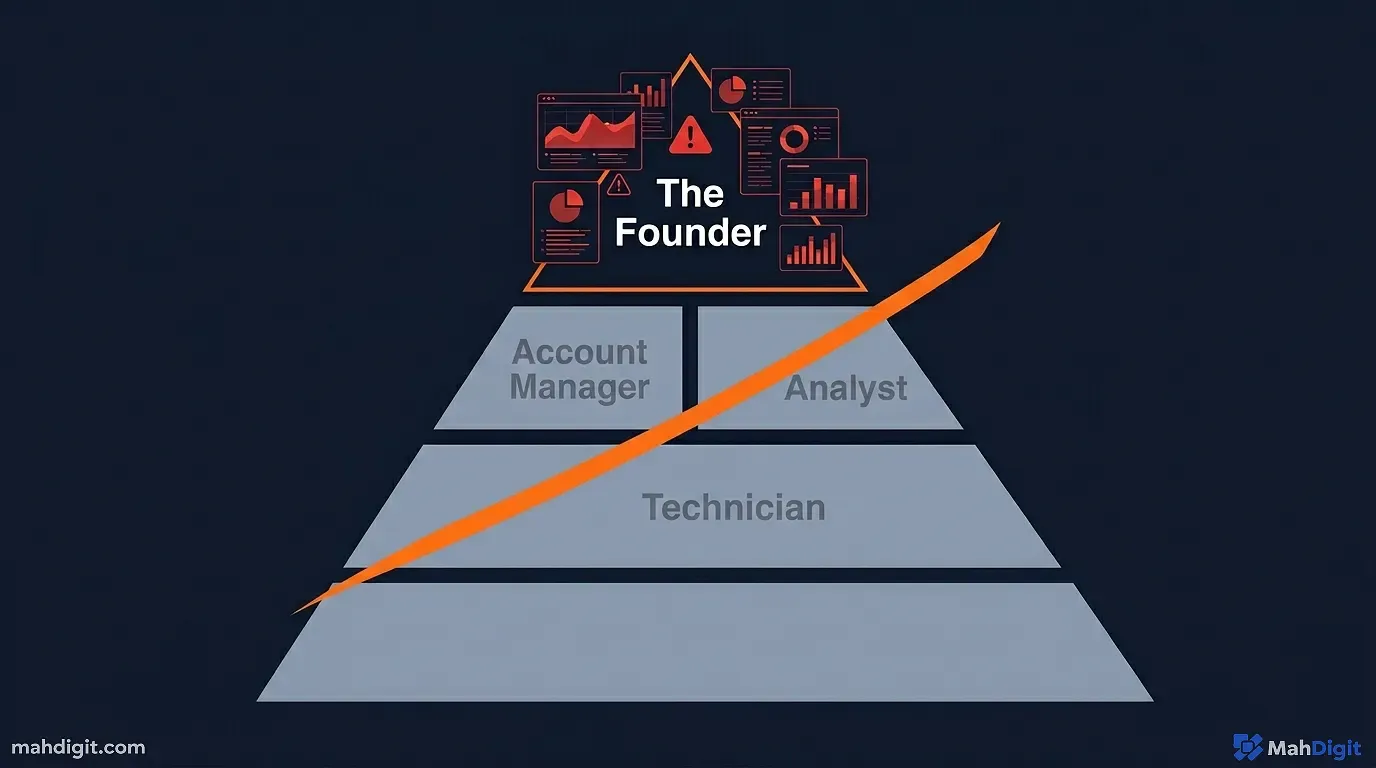
Let us look at a traditional digital marketing or operations agency. To service five high-ticket clients effectively, you usually need a specific roster of recurring talent:
- An Account Manager: To handle client emails, onboarding, scheduling, and weekly reporting.
- A Researcher/Analyst: To gather technical data, monitor competitors, or scrub lead lists.
- A Creator/Technician: The person actually writing the copy, designing the graphics, or writing the local SEO landing pages.
- The Founder: You. Trying to sell the next client while putting out fires set by the first three.
When you try to transition from freelancer to agency, hiring those first three roles kills your profit margin. In a standard mid-market agency, payroll consumes 50% to 60% of gross revenue. In 2026, the strategy is drastically different: you replace the first three roles with software.
Role 1: The AI Account Manager (Client Communication)
Clients want to feel heard. They want immediate responses to their tactical questions, and they want consistent weekly updates without having to ask for them. This administrative burden traditionally eats up 30% of an agency owner’s week.
The Solution: An orchestrated CRM + RAG (Retrieval-Augmented Generation) system.
Building the RAG Brain
Instead of hiring an Account Manager for $60,000 a year, I use a platform like GoHighLevel or HubSpot AI Suite integrated with an orchestration tool like Make (formerly Integromat).
When I take on a new client, I build a specific “Client Brain.” This is a dedicated database (often using Pinecone or even advanced Airtable setups) where I dump every single project note, Zoom transcript, finalized strategic document, and previous email thread.
The Execution Loop
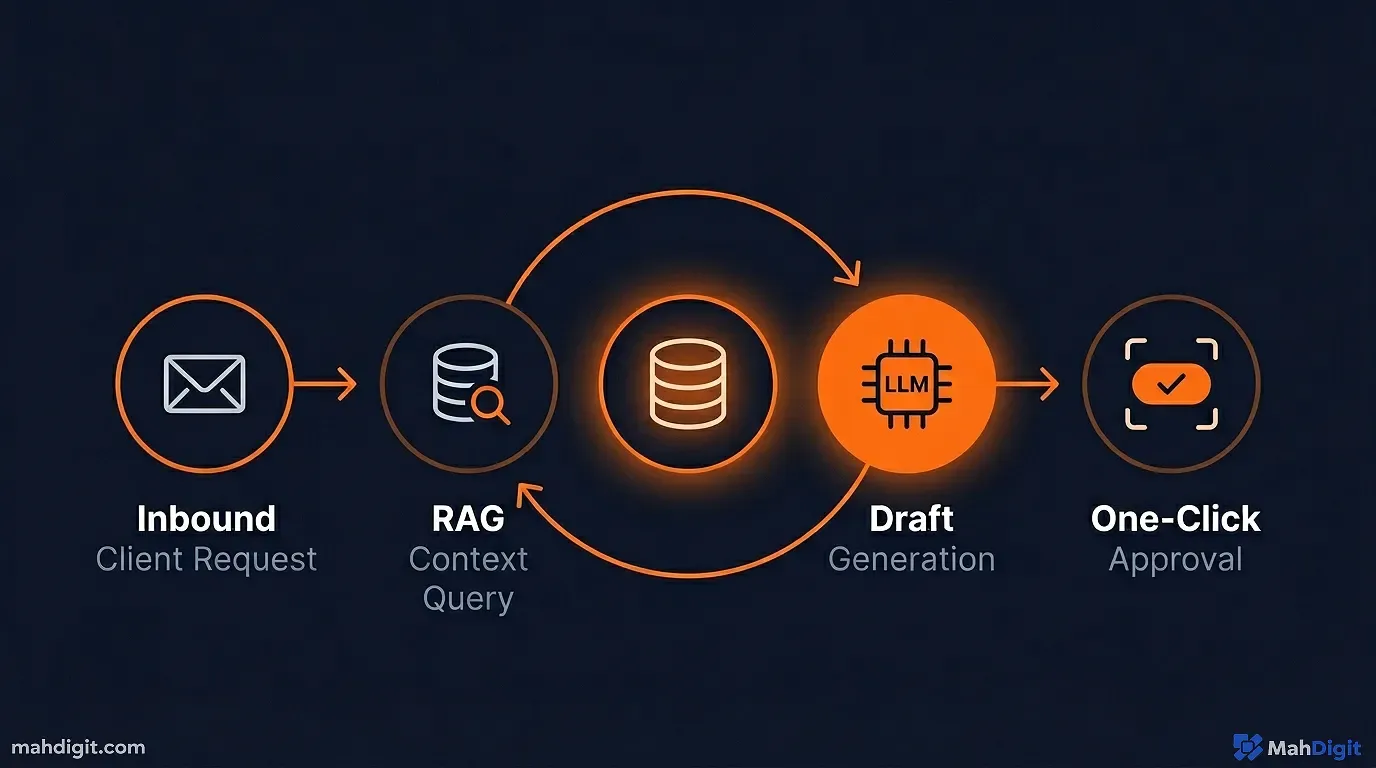
When a client emails my agency with a question like “Hey, what is the status of the Q3 email sequence?” the automated workflow triggers:
- The Interceptor: The orchestrator spots the inbound email via Gmail natively.
- The Query: It queries the specific client’s vector database to pull the most recent timeline doc for the Q3 campaign.
- The Drafter: It feeds that context to an advanced LLM (like Claude 3, which excels at tone) and prompts it: “Draft an empathetic, accurate update based on these notes. Mention the delay on the graphics but confirm the copy is done.”
- The Gatekeeper: The draft sits in a hidden Slack channel. I scan it. I click a simple “Approve and Send” webhook button, and the email fires to the client from my address.
I just eliminated three hours of email triage a day. The client feels incredibly valued because they got a detailed, accurate response in ten minutes instead of two business days. I never felt anxious opening my inbox because the heavy lifting of context-gathering was already handled.
If you do not know how to set up these webhook connections or build simple RAG applications, my guide on No-Code AI Automation breaks down the fundamental logic of tying these exact platforms together without writing raw Python.
Role 2: The AI Researcher (Data and Strategy)
The most valuable service an agency provides is not just doing the manual work, but knowing what work to do based on competitive data. Gathering this data used to require hiring junior analysts to stare at spreadsheets and Google Search results until their eyes bled.
The Solution: Autonomous Research Agents.
Let us say I am running a specialized agency that does competitive keyword analysis for B2B SaaS companies. I do not manually read through their competitors’ websites. That is a terrible use of my strategic brain. I use Agentic AI tools like MultiOn or a custom-built Zapier Agent.
The Headless Browser Tactic
I give my custom agent a single, high-level prompt:
Find the top five software competitors to Client X in the European market. Autonomously navigate to their pricing pages and their last ten engineering blog posts.

Extract their pricing tiers, the core features locked behind the highest tier, and the primary keywords used in their H1 tags on the blog. Output a JSON competitive matrix identifying their strategic weak points where Client X can compete.
The agent autonomously uses a “headless browser” a web browser running in the background without a graphical interface to navigate the web, scroll, click, read, and synthesize the information. It dumps the final matrix into a clean Airtable base.
I run these scripts overnight. I wake up to the work of a Junior Analyst completely finished, formatted beautifully, ready for my high-level strategic review.
Role 3: The AI Technician (Execution)
This is the role everyone focuses on because it is the most visible, but it is actually the easiest to solve in 2026. This is the writer, the basic coder, and the mass-asset generator.
The Solution: Fine-tuned LLMs and specialized SaaS nodes.
If your agency offers high-volume content, you do not use raw ChatGPT via the public web interface. That results in generic, plastic-sounding text. You build a custom GPT or use an AI Studio environment (like Google AI Studio) populated with the client’s strict brand voice guidelines, their past successful content, and aggressive negative prompting (listing the corporate buzzwords they explicitly hate).
Shifting from Chat to Workflows
The key to scaling execution is abandoning the chat interface entirely. You build Workflows.
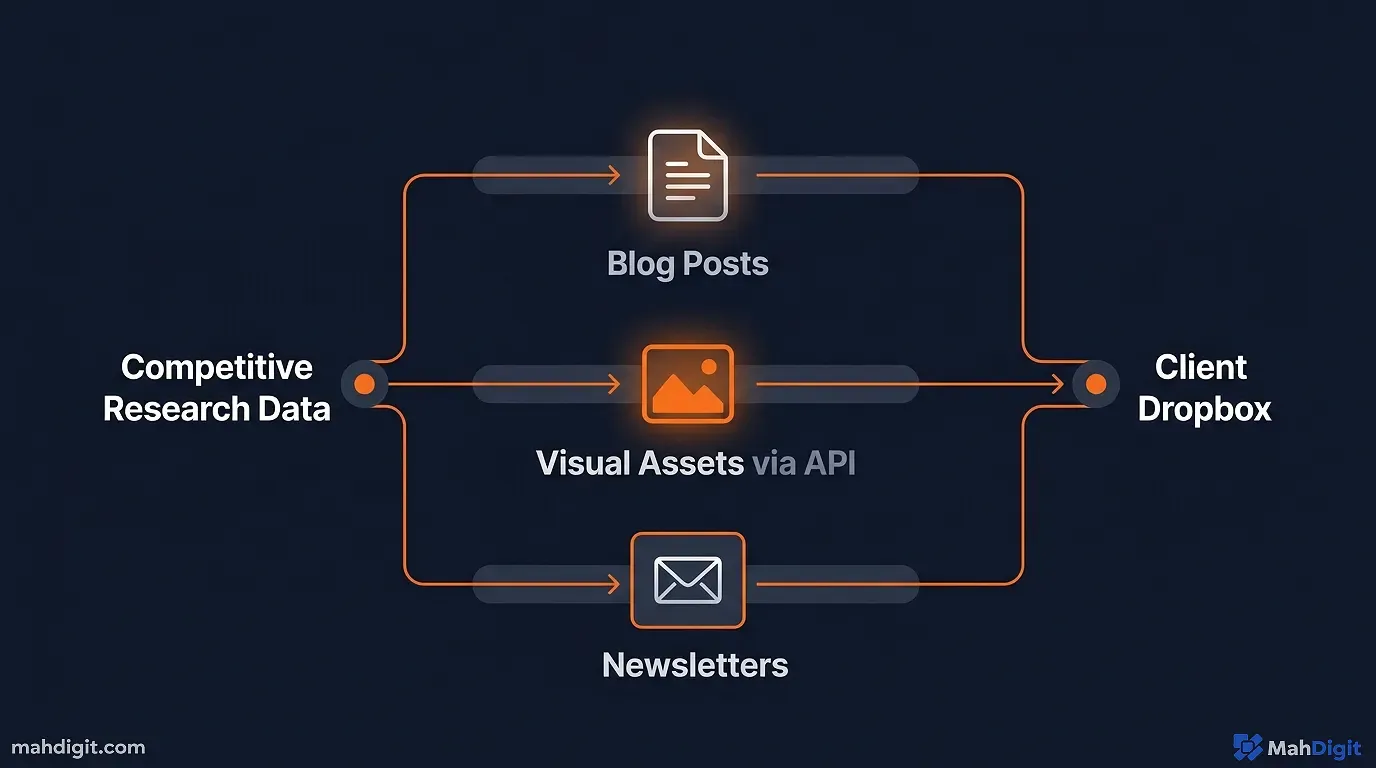
For example, I set up n8n workflows that take the competitive research gathered by the AI Researcher (Role 2) and pipe it directly into my customized AI Technician node. It systematically generates the necessary blog post drafts, social media updates, and email newsletters based on that research, dropping them all into a Google Drive review folder.
To see how a high-level orchestration platform handles this kind of bulk technical execution efficiently, read my teardown in our no-code AI automation guide.
Automating the Graphic Designer
Writing text is one thing, but clients expect visual assets. In 2023, you had to hire a junior designer to sit in Canva for six hours manually resizing Instagram carousels. Today, we automate the visual pipeline entirely.
Let us assume your agency produces a daily newsletter for a construction firm. They need a custom hero image every single day. Instead of firing up Photoshop, my automated workflow takes the title of the daily newsletter and routes it to an image generation node (like Midjourney API or a local Stable Diffusion model).
The prompt is hardcoded to ensure brand consistency: “An architectural sketching style illustration of [Topic], navy blue and gold color palette, minimalist, clean lines, corporate vector art.”
The generated image is then passed to a Bannerbear API node. Bannerbear acts like a programmatic Canva. It takes the AI-generated image, slaps the client’s logo in the corner, lays the newsletter title over it in their exact brand font, and saves a 1200x630 web-optimized file straight to their WordPress media library.
This entire visual pipeline runs in the background. It takes zero human hours. When I pitched this exact workflow to a real estate firm, they fired their expensive third-party graphic design retainer the next day and hired my agency instead. I charge them $1,500 a month for assets that cost me $9 in API fees. The leverage is unimaginable.
The Human Mandate: Your Role as the Orchestrator
If AI is doing the account management, the deep research, and the daily execution, what are paying clients buying from you? Why don’t they just buy the AI tools themselves?
They are buying your judgment and your architecture.
This is why generalist consulting agencies are dying rapidly in 2026. If a client just wants a generic blog post, they can use an AI tool themselves. But a local HVAC business owner does not know how to stitch an Airtable database to a custom Llama 3 model, pipe it back to a Twilio SMS responder, and fully automate their chaotic lead follow-up system.
Your job shifts from “doing the manual work” to “building the autonomous machine.”
The Three Pillars of the Orchestrator
- Strategic Scoping: You diagnose the client’s actual, underlying problem. They think they need “more SEO.” You realize they actually need an automated intake sequence to stop losing the leads they already have. You figure out which specific AI tools will solve it.
- Workflow Construction: You design the Zapier, Make, or n8n pathways. You set up the webhooks, manage the API tokens, and handle the error routing when things break.
- Quality Control: You are the final set of eyes on everything the agents produce. You inject the E-E-A-T (Experience, Expertise, Authoritativeness, Trust) that algorithms cannot replicate, a concept I cover in my getting started with ChatGPT guide when discussing how to pass strict manual reviews.
Evolving Your Pricing Model
When you transition to an AI Automation Agency, you have to kill the hourly rate immediately. It is the fastest way to bankrupt yourself and penalize your own efficiency.
If you charge $100 an hour, and an AI agent allows you to execute a complex data migration in 14 seconds instead of the 14 hours it previously required, billing hourly means you make zero dollars. You are punished for being fast. You must shift to Value-Based Pricing or Retainer Models.
The “Transformation Partner” Retainer
Instead of selling a commoditized service like “I will build you three Zapier automations for $1,000,” you sell a business transformation based on ROI.
Here is the exact pitch structure I use: “I will act as your fractional AI Operations Director. For $3,000 a month, I will audit your internal systems, build autonomous agents that reduce your manual data entry by 80%, and train your team on how to manage them. I am not selling you a script; I am buying you back 40 hours of staff time every week.”
You lock the client into a six-month minimum. You spend the first month building the large, complex workflow on your home server (using a stack outlined in our no-code AI automation guide). For the next five months, your agents do the heavy lifting in the background while you simply monitor the servers, handle edge cases, and collect a large profit margin.
Building IP (Protecting Your Moat)
As you solve specific problems for clients, do not reinvent the wheel. Treat every solution like a product.
If you build an incredible AI agent that automates cold email outreach and follow-up specifically constructed for commercial real estate brokers, take note. That unique workflow configuration is your Intellectual Property (IP).
You can package that exact blueprint and sell it to 50 other brokers across the country as a pre-built, plug-and-play solution. You charge an implementation fee and a monthly SaaS-style maintenance fee. Your service-based agency slowly morphs into a scalable, high-margin software business. This is the main endgame of the solo operator.
Financial Comparison: Traditional Agency vs. AIAA
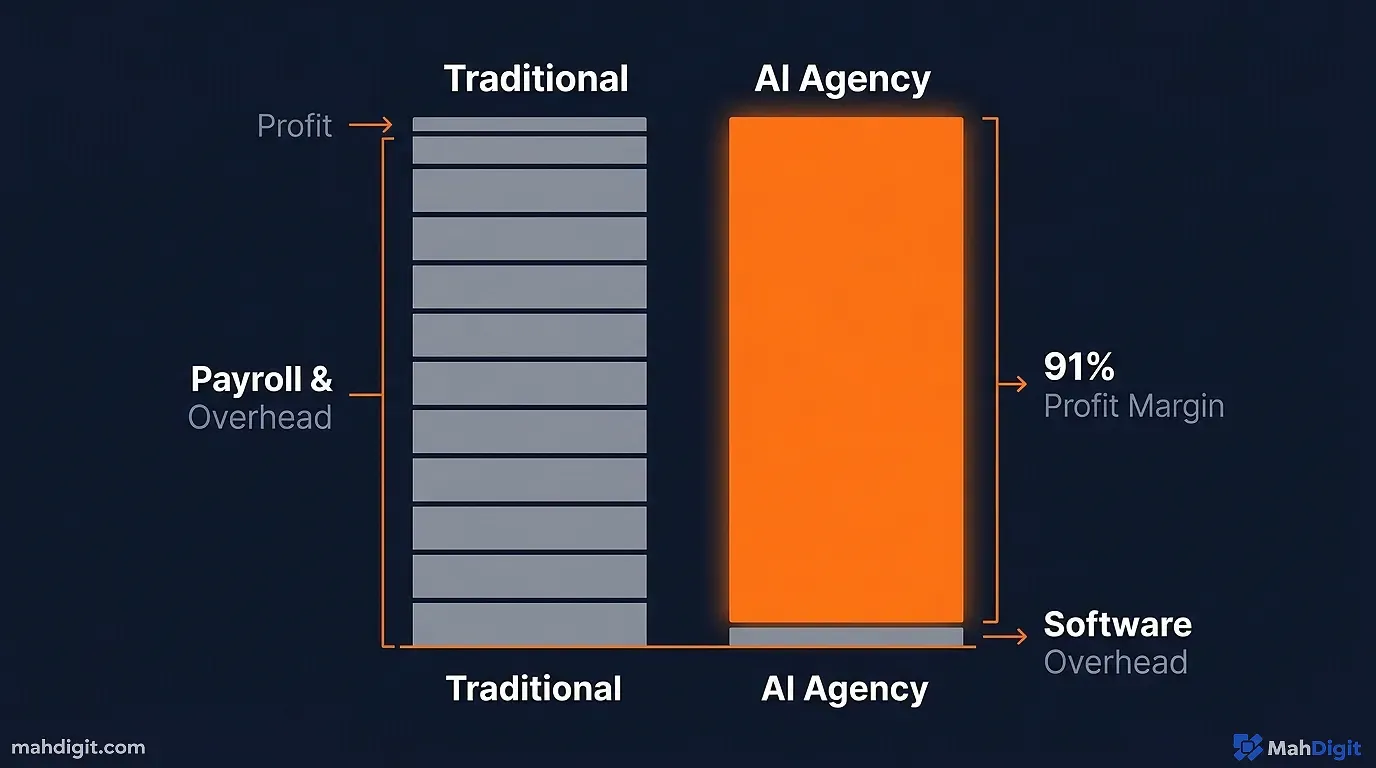
To truly grasp the power of this shift, look at the math of operating a micro-agency with five high-ticket clients paying $3,000 a month ($15,000 Total Gross Revenue).
| Expense Category | Traditional Agency (3 Staff) | AI Automation Agency (Solo) |
|---|---|---|
| Gross Monthly Revenue | $15,000 | $15,000 |
| Payroll / Contractors | $8,500 | $0 |
| Software Subscriptions | $400 | $1,200 (API costs, premium tiers) |
| Office/Admin Overhead | $1,000 | $150 (Home office basics) |
| Net Profit (Owner Take-Home) | $5,100 (34% Margin) | $13,650 (91% Margin) |
| Stress Level | Insane. Managing humans is hard. | Moderate. Managing APIs requires focus. |
You are producing the exact same work for the client, if not faster and more accurately, but you are keeping nearly all the capital.
Key Takeaways
Scaling an agency in 2026 requires leveraging software, not thoughtlessly expanding headcount. By orchestrating Agentic AI, a solo operator can deliver enterprise-level results.
- Move beyond Chat Interfaces: True AI agencies do not copy and paste from ChatGPT. They use orchestration platforms (Make, n8n, Zapier) to wire AI agents directly into databases and communication tools.
- Automate Account Management: Use RAG systems to query client data and draft instant, accurate status updates, saving you hours of daily inbox triage. You review, click send, and look like a hero.
- Deploy Autonomous Researchers: Use web-browsing agents to passively scrape and synthesize competitor data or industry trends overnight while you sleep.
- Shift from Technician to Orchestrator: Clients do not pay you for raw AI output; they pay you for your strategic architecture and your ability to stitch complex systems together seamlessly.
- Never Bill Hourly: When automation drops task time to zero, hourly billing kills your business. Charge retainer fees based on the main ROI and time saved for the client.
- Productize your Workflows: Identify the repetitive agent systems you build for clients and repackage them as standalone digital products or specialized software-as-a-service (SaaS) offerings.
- Protect Your Margins: A solo operator with a $1,000 monthly API bill will always out-compete a traditional agency carrying a $10,000 monthly payroll burden.
The freelancer trap forces you to trade time for money. The AI Automation Agency forces you to trade logic for money. It is the highest leverage game you can play right now. Learn the tools, build the agents, and start firing yourself from the repetitive tasks dragging down your business. Ready to go deeper? Explore building an AI workflow and automating social media with AI.
